Crossing the border from Vietnam into China once again proved the divide that a small river can create. From the Vietnamese side we left behind ramshackle French-colonial buildings and wide streets for Soviet-esque cement buildings hunched over narrow streets in China. Equally, English disappeared but so did the rapid-fire, unsolicited requests to spend money.
Immediately China stood above us, four storeys high and filled with signs indecipherable to us. A short walk took us to the bus station and our transport to Kunming, the capital of Yunnan province. Unfortunately the only transport option was the 'sleeper bus', 'sleeper' in inverted commas because there wasn't much sleeping done. The sleeper bus is essentially a slightly-tall coach, but instead of seats there's small beds arranged in three rows running the length of the coach, and bunk-bedded two high. At the beginning of the trip the beds seemed just long enough for Claire and I, but shrank the further we got into our 14-hour trip. Whilst the map indicated we'd take a highway to Kunming, the bumping and swaying demonstrated a more circuitous path of 'short-cuts', some of which seemed to take the bus through plowed fields. Anyway, we finally made it to Kunming and fell asleep at the guest house.
The people, too made us instantly feel like we were in China. Very willing to approach us for a chat, Chinese sentences quickly role off their tongue. They have a different attitude too, within 1 hour of being in China we saw our first angry, public dispute and have continued to see them since. Thankfully, however, their attitude towards tourists is much more relaxed. After a month of being cajoled, summoned and pulled by Vietnamese hawkers its a pleasure to just stroll through town without having products thrust in our face. There's far more smiling amongst the Chinese than the Vietnamese.
01 September 2007

30 August 2007
Sapa
Up in the north-west of Vietnam is a small town called Sapa. Surrounding the main town are stunning views and 5 minority (the Vietnamese term) peoples. For two days Claire & I trekked through the valley and had some interaction with them - though it was predicated upon commercial interests (we now have more souvenirs than we want). The scenery was spectacular, with high cliffs along to our left and right, and villages and rice paddies spread along the cliff faces.
The H'Mong people in particular seemed to take a liking to Claire, making her presents of grass horses and a fern tiara.
The scenery was spectacular, with high cliffs along to our left and right, and villages and rice paddies spread along the cliff faces.The H'Mong people in particular seemed to take a liking to Claire, making her presents of grass horses and a fern tiara.
29 August 2007
Another Claire


Back home in Melbourne there are multiple Claire's, such as "At Home Claire", "In the Studio Claire" or "Attending an Exhibition Opening Claire", each with their own set of accessories and activities and . Since coming away I've discovered another I didn't know existed - "Adventure Claire".
Adventure Claire treks through rainforests and flies over their canopies, fords rivers, kayaks, scales waterfalls, feeds bears, rides elephants, enjoyes motorbikes and always manages to maintain her smile.
For a morning walking with the H'Mong people in northern Vietnam she even managed to become Princess Adventure Claire, being crowned with a fern tiara.
27 August 2007
How Long Bay


From Hanoi Claire & I spent three very relaxing days floating through Ha Long Bay. In a renovated junk boat we gently cruised in amongst the islands, stopping for swimming and kayaking along the way. On the first afternoon we were able to take the kayak under a small cave in one of the limestone islands into an internal bay, entirely surrounded by sheer cliff faces.
On our final day we (Claire, I and two friends met on the trip) ate at the only free table in a restaurant full of a group of very drunk Vietnamese. Rice wine, beer flowed and the group got into their party tricks, one singing Vietnamese opera and another drinking beer through his nose. One of the group, a lady, came over to practice her English and explained that the group were army and government officials celebrating the conclusion of a training course.
During our discussion, the singer came over and our translator explained he was a high ranking military official, and that he'd like to toast with us. Glasses and a bottle of rice wine quickly appeared. Our host drank a shot to each of ours, then broke into a tune each verse of which was interspersed with another round of shots. After he'd proved he was a big man by downing 7 shots in 5 minutes with the foreigners we made a polite exit before the second ranked man decided to do the same.
24 August 2007
Hanoi
Hanoi's proven to be my favourite city in Vietnam so far. Once out of the peak tourist area, it's possible to see life 100 years ago. The French colonial era buildings stand out unlike most cities, and unlike Hoi An it's a living city rather than a museum (Claire's analysis). Life goes on on the small streets much more clearly than elsewhere and walking around gives the impression of participating.
The central lake in Hanoi has a particularly mystical fell, with its deep green colour, pagodas built on small islands, willows hanging over the edge and completed with mist. It's integrated into the city and you can see Hanoians really use it as part of their daily life - to meet, play chess, or hold hands.
After Hanoi we're going to Ha Long Bay for a few days, then Sapa in northern Viet Nam, after which we cross into Yunan province in China. It might be quite a while before the next post.
23 August 2007
Saigon/Ho Chi Minh
Claire & I have just spent a week in Ho Chi Minh City/Saigon and the surrounding area.
I, and I believe most visitors, was struck first by the traffic. Crossing the street's a hair-raising experience, in which hesitation is even more costly than when running between the wickets. Everyone says "just keep walking, don't look", but I don't think it's as straight forward as that.
Being back in a big, big city reminded me of my time in Bangkok, and I've a feeling Saigon will look more like Bangkok in the next 5-10 years (more high-rise buildings, more cars). I really enjoyed pulling up a seat at a cafe or street restaurant and watching the world go by, though the touts could get a bit much.
From Saigon we did a trip out to the Cu Chi tunnels - the underground complex dug by the Viet Cong during the American war for defense, attack, and living. Though I tried I didn't manage to crawl down the tunnels as claustrophobia got the best of me. A glance down their dark, tight confines was enough to give me an idea of what the living conditions would have been like.
After that we took a tour through the Mekong Delta, the highlight of which was the floating market. From a collection of boats farmers sold their goods to locals each day, the produce for sale on each boat indicated by tying an example to a bamboo pole on the boat's prow. Though there were plenty of tour boats taking in the market, it felt good to see something that's naturally a part of Vietnamese life and not adulterated for the tourist market.
14 August 2007
Get Your Motor Runnin'


So to get off the conveyor belt Claire & I joined a three-day motorbike trek travelling from Nha Trang our destination was Dalat via Vietnam's central highlands. Even though we were only passengers, there were still many renditions of 'Born to be Wild' abounding.
This was my first time on a motorbike - not counting a few rides on scooter-taxis in Bangkok. Initially trepidation reigned, but I quickly settled in and by the last day was taking photos as we rode along. That said, there were a few nervous (as I unsubtly but evocatively describe them as 'arse-clenching') moments when the gap in the traffic looked just a little too small for our bike. The trip certainly gave me an understanding of how people drive in Vietnam, which seems to involve weighing up the speed of all vehicles, size of the vehicles and space on the road when determining if you should back off or go ahead. At one point we overtook a truck and two motorcycles into an oncoming motorcycles so my driver had gauged 5 vehicles speed and the available space. Just.
The countryside provided a rolling background of hills (with winding roads) and rice paddies (with straight roads) that we alternatively crawled and raced along. On the first day we repeatedly passed hills still deforested by agent orange 40 years later.
The region had been flooded by a typhoon a week ago (hence the 36 hours of rain in Hue/Hoi An) which had left the rivers swollen and waterfalls we visited barely a 'fall' at all, rather a lunge off the cliff edge.
The trip also provided the opportunity to spend time with our guides, likely one of our few opportunities to spend a concentrated amount of time with a Vietnamese person on the trip. It was good to get a glimpse into how they see the world. It's also been interesting to compare the industrious, prosperous Vietnamese (a capitalist wet-dream in a communist country) against the passive, impoverished Laos.
11 August 2007
Tourism Conveyor Belt
After Lao's dishevelled systems, Vietnam's tourism machine came as a bit of a shock. A week and three cities showed how easy travel is here, and how easy it is to just be moved along. You wake at the guesthouse (located in a tourist area: guesthouses, food, beer, internet), get on the prearranged bus, get dropped off in the tourist centre of the next city, go on the organised day tour, spend money on the arranged objects and then get on the next bus.
On a similar note, the selling of 'Asian-esque' products is one that worries me. Shops here (and throughout South-East Asia) are filled with factory made products with Asian motifs. I just hope that in producing these mock-Asian products, the skills, reasons, traditions and creation involved in the development of the original models isn't lost.
On a similar note, the selling of 'Asian-esque' products is one that worries me. Shops here (and throughout South-East Asia) are filled with factory made products with Asian motifs. I just hope that in producing these mock-Asian products, the skills, reasons, traditions and creation involved in the development of the original models isn't lost.
10 August 2007
Nha Trang


Nha Trang was our first beach experience in a while, and was suitably rewarding. Blue waters, golden sands, palm trees and more cliches than you can point a stick at made for a relaxing break. On our second day in Nha Trang we took a day trip around several islands, which was worth every cent of the $6 we paid for it.
08 August 2007
Hue and Hoi An


Our first two stops in Vietnam were Hue and Hoi An.
Hue's a former capital, home to the no longer forbidden, Forbidden City. Though much of the former palace complex was ruined in the American war several key buildings still stand and occupied a morning for us. After Lao's quietness, Hue was a nice transition into Vietnam - more bikes, more people, excellent food and much to spend money on. It took Claire 4 hours in the country to purchase a new blouse - not quite beating her 3 hour record set in Bangkok.
Hoi An, a UNESCO protectorate, and home to a thousand tailors operating in the former colonial town. The old town's protected and technically doesn't allow motorised transport within its precincts. Strolling around town is a look back 150 years (nearly). One evening we sat on the porch of a large bar and pretended to be French colonialists retreating to a place of safety, a reminder of home, amongst the incomprehensible orient.
We also took the opportunity to have some clothes made. It only took three extra skirts to realise the correct answer to the question "Just one more?" is not to purchase just one more, but rather to back out of the store quietly.
04 August 2007
Out of Lao

A couple of bus trips took us out Lao and into Vietnam. The Lao immigration office was a poor cement building, the Vietnam office and welcome arch large, expensive and a touch tacky.
Here's my final reflections on Lao:
1. The countryside, national parks and natural attractions are beautiful and unspoilt. This might be more to do with poor economic development, but for now there's lush forests, jagged limestone hills, and stunning waterfalls. Hopefully these things are protected.
2. The people in each town seem to have a different attitude, swinging from delightful to recalcitrant depending on the city.
3. There's not much in the cities.
4. The food is really, really plain.
5. Travelling in a developing country's let me see a different side of life, which I really appreciate.
02 August 2007
Waterfall of the Mind


Down in Southern Lao Claire & I found one of the most beautiful spots in South-East Asia. Waterfall Tad Fein comprises two rivers meeting the edge of a cliff a few metres apart and plunging 120ms to the valley floor. We stayed in the resort overlooking the falls for two nights, the sounds of crashing water lulling us to sleep and views of the waterfall available from our balcony. It was cold to the point that we had jumpers on, and mist rolled in and out of the valley and surrounding forest through the two days we were there.
Our first afternoon provided full views of the waterfalls, we just watched quietly for a while, and then tried feebly to put our response into words to each other. Claire has brought a book with her entitled Mountains of the Mind, which explores peoples' reaction to mountains specifically and landscapes generally. In short, it proposes that our interpretation of a lanscape is dependent upon our personal and cultural backgrounds. Watching the water plummet I fit firmly into the modern category - awe at the sublime, sublime being an inarticulate-able combination of the beautiful and terror.
01 August 2007
Biggest Dump in Lao

Savanakhet occupied (unfortunately) 3 nights on two transits of our time. If you can avoid it, don't come here. The guest houses are terrible, food worse (can food be 'extra' bland?), and the people unpleasant - it feels like you're a burden when you want to purchase food in their restaurant.
It was interesting, however, to be in a town that appears to be dying. It was formerly a French colonial trading point, and as such contains many French built buildings, and in it seems too many for the population. The Lao population feels lost in the town, unable to afford any upkeep, the same money seems to go around from one shop to another, neither increase nor improving the town. It feels stagnant, barely clinging on.
31 July 2007
Na Hin


A ride through limestone caste mountains and heavily foliaged countryside got us to Na Hin, a tiny town in central Lao. For such a low-key point of our trip, it turned out to be a real highlight.
The town's nestled in a ring of mountains, jagged topped and tree laden. The main street is dirt & stone, and consists of little more than the central market, 2 restaurants and a guesthouse. Animals - pigs, cows, goats, dogs - wander around, and sometimes over to you for a curious look. The people were friendly, popping up to see if there's anything we want, or just for a chat to practice their English. We met one child, about 8 years old, who spoke very colloquial English despite never having left the village. In the evening we sat at a bar in the market, whilst Laos played pool, cows settled down to sleep, and a raging storm let loose its lightning over the mountains.
What I liked about the experience was the opportunity to just settle in and watch life in a different place, culture, and economic strata. It was so different to back home - mostly friends just talking.
Getting There, Some How - Travelling Lao style
With a "just flag anything down, you'll be fine. A sang taew should take you" our friends dropped Claire & I besides Route 13 - the main road heading south - and sped off towards Vientiane in the tuk-tuk. Looking around me I saw our a road, a restaurant and a few empty fields. The first two sang taews (utes with benches in the back) didn't stop. The next one didn't know the name of the town I was trying to get to and the fourth told us sang taews didn't go that far (I think) - that we'd need to get a bus. Thankfully the word for bus is the same in Lao as in Thai.
Shortly after a bus came rolling around the corner and Claire & I jumped on, getting wedged into the back seat, our bags taking up the aisle. The ride was four hours of un-air-conditioned joy, and the pancake we'd had for breakfast was starting to look thin. Finally the conductor motioned us to get off, we alighted again near a restaurant and little else. With a little help we found our way to the sang taew heading East towards our destination. Sharing the ride with us was three generations of Lao women, all dressed in their traditional, intricately woven dresses, the eldest of whom was chewing beetle-nut and who was less than pleased when we stopped to help another sang taew with a flat tire. An hour ride through a forest encircled by limestone caste mountains took us to our destination that day and dropped us just an hour before sun down. We spent the night in Na Hin, which I'll cover in the next post.
The second day of our unconfirmed adventure began with us trying to get to Tang Lo caves - an 8km cave that you can boat down in located in a national park. We awoke early and were at the market by 8, only to be told the only Sang Taew didn't leave till 11 and that the road was washed out so we'd need to take a boat part of the way. We sat for a while and contemplated a cow as it tried to push through a gate from its paddock to our seating after which we checked with the drivers how much the boat would coast - US$50 return! An exhorbinant amount due to tourism and the need to charter the whole boat with no other tourists to help bear the costs. Normally $50 wouldn't be too much of a problem, however we'd not budgeted for it, were going to have to spend more on food & accom than anticipated when I last drew money out and the nearest ATM or Bank was 2 days travel away in Vientiane or else in Vietnam. With much mathematics and reluctance we abandoned our plans to get to the caves.
Rushing now, we boarded the first Sang Taew back to route 13. From there we were efficiously transferred to a second Sang Taew, and 1.5 hours down the road into a minivan for the last leg, dropping us in Savanakhet. The minivan leg we shared with 17 others, though the bus seated 12 including the driver. Next to me was a girl of 4 or 5, when we stopped for a snack her parents bought her roast grasshopper on a stick, which she was very happy with.
I've come to know now that travel in Lao takes 2-3 hours per 100kms by bus or boat. I've also never travelled with so little certainty of being able to actually get to my destination, which is a liberating experience and travelling local style has let me see a little more into the lives of the Lao people.
29 July 2007
Vientianne
An 8 hour, difficult bus ride from Luang Prabang (I've since learnt that the westerners living here all fly to avoid the trip) brought us to Vientiane. For the first 4 hours of the ride we were in the mountains of central Lao, twisting and turning to avoid a gradient. It was a bad sign when the bus-staff handed out sickness bags, and shortly after departure several people on the bus began to make room for lunch. At the lunch stop several more dashed from the bus to the nearest bush. Yours truly felt queasy enough not to eat lunch, but otherwise made it through ok.
Vientiane occupied our next few days, including taking in the major sights through a leisurely 2 hour bike ride, catching up with friends, and Claire did a one-day dying & weaving course at a local women's training centre. Vientiane's small, restaurant filled and reminds me most of Mornington (less the yuppie factor). I still find it odd to look across the Maekhong to see an unimportant Thai city that seems bigger and more 'developed' - if shopping malls and cinemas are the judgment measure. As I'd been to Vientiane before this part of the trip was mostly about catching up with a friend, and Claire really enjoyed the weaving.
Over the weekend a couple of friends, Claire & I traveled to Ban Pako eco-lodge in a park a few hours from Vientiane by tuk-tuk & boat. It was great to push back beside the river, have a few beers and watch the old-growth forest not be logged. We even got a massive lightning storm to provide a light show.
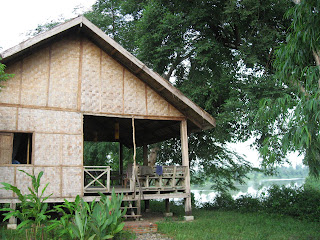
The eco-lodge was also hosting a meeting for Lao forestry students, about 100, who slept in tents during the storm. That didn't stop them being up at 5am, singing, playing drums and guitars, and generally getting very excited whilst they waited for their bus. We had an excellent seat for the concert as the bus-stop seemed to be right outside our room.
Vientiane occupied our next few days, including taking in the major sights through a leisurely 2 hour bike ride, catching up with friends, and Claire did a one-day dying & weaving course at a local women's training centre. Vientiane's small, restaurant filled and reminds me most of Mornington (less the yuppie factor). I still find it odd to look across the Maekhong to see an unimportant Thai city that seems bigger and more 'developed' - if shopping malls and cinemas are the judgment measure. As I'd been to Vientiane before this part of the trip was mostly about catching up with a friend, and Claire really enjoyed the weaving.
Over the weekend a couple of friends, Claire & I traveled to Ban Pako eco-lodge in a park a few hours from Vientiane by tuk-tuk & boat. It was great to push back beside the river, have a few beers and watch the old-growth forest not be logged. We even got a massive lightning storm to provide a light show.

The eco-lodge was also hosting a meeting for Lao forestry students, about 100, who slept in tents during the storm. That didn't stop them being up at 5am, singing, playing drums and guitars, and generally getting very excited whilst they waited for their bus. We had an excellent seat for the concert as the bus-stop seemed to be right outside our room.
26 July 2007
Luang Prabang

The former royal capital - mainly former because the royal family is presumed to be 'former' - was a welcome destination for a few days. Now protected by world heritage status, Luang Prabang maintains the vestiges of an Asian capital with colonial influences - basically the main strip of town hasn't changed in 150 years.
The view from the hill (including wat) that overlooks the city was probably my favourite, taking the town, palace, river and jungle beyond. We spent a day looking around the sites, a day at the waterfall, and a day shopping and having a massage, things that probably should have taken us two days only. The waterfall also has an animal recovery centre for a tiger and asian bears recovered from animal poachers.
After spending time in not-nice Huay Xai it was nice to meet the 'lovely' Lao people that friends and guidebooks have mentioned. The next stage is for us to find the cheap food promised as we are finding local food to be costing 2-3 what it would in Thailand.
21 July 2007
Driftin'

From the Lao-Thai border we drifted at a leisurely rate on the boat to Luang Prabang, the former royal capital. Tellingly the ferry journey is known as the 'slow boat' and takes 2 days, encompassing 15 hours of boating. As the only other option is the oft fatal 'fast boat' Claire & I purchased cushions and prepared to sit for a long time. At the initial boarding we were pleased to grab the 'first class' seats - cushioned seats pulled from a bus - rather than the benches, and were even more so when the boat owner brought on boards plastic seats to fill the aisles. I suspect that the boat was at about double its capacity, and the punters rage higher than that. Thankfully just before we set sail the owner decided to send a second boat and we traveled in a relatively less congested manner.
Surprisingly, the trip was quite pleasurable as there were some nice people on the boat to talk to and the scenery beautiful. The second day, in particular, provided some spectacular scenery - the chocolate river, lush green forest, and in the distance near transparent mountain ranges.

Late on the second day two members of one of the Lao hill tribes joined our boat for the ride to Luang Prabang. Marginalised and impoverished the tribes people have have received little if any schooling, many not even speaking the national language. At one point, one of the western tourists was writing in her journal, the tribesman lent over to watch her write, fascinated as he saw the unintelligible scrawl fill pages. I assume that he knew what writing is, but was entranced to watch it actually take place.

19 July 2007
The Mud Experience
For our first three days in Lao, Claire & I joined a trek into the Bokeo National Park rain forest with The Gibbon Experience group (www.gibbonx.org).
The trek involved a 4 hour walk into the rain forest including very high zip-wires/flying foxes across the valleys, two nights in a tree house in the the rain forest canopy, and then a walk out. I even took the optional 6 hour walk on the second day. Ideally you can see or hear gibbons near the tree houses but we weren't so lucky.
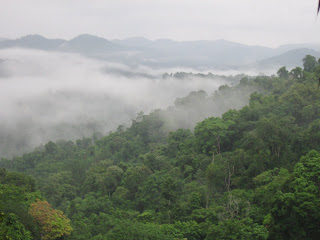
The zip-wires were a definite highlight. Pushing off from the platform you quickly gather pace as you whip passed bamboo and trees, with a rush break out of the last tree and then sail over the rain forest canopy 30ms below, the floor 2oms further, and have views stretching kilometres away over the rain forest. It's the closest I'll come to flying and only temporarily scary on the longer glides if you think about what you're doing.

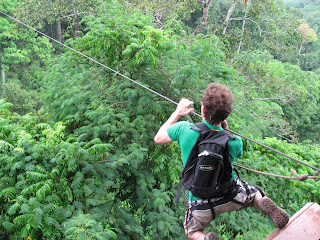 Another highlight was the opportunity to be in the rain forest, which is amazingly detailed a ground level and awe inspiring at canopy level. Noise never stops in the rain forest, even if our sightings of wildlife were low.
At the first local hut we stayed they had a pet baby Asian bear which was highly cute and pat-able. They had no plan of what to do with it when it reached adulthood.

The walks were particularly demand as, having chosen to take the trip in the wet season, most of the paths had turned to deep mud. Living in the mud were also highly active leeches. At one point I was eking along over a very deep mud patch, one foot on the less-slippery edges of the path when I looked down to see several large leeches waving up at me, begging me to slip. I didn't slip that time, but did on many occasions. Amazingly Claire & I managed to only get blood-sucked on one occasion each, though vigilance did lead to a lot of picking & flicking of leeches off shoes, legs and feet.
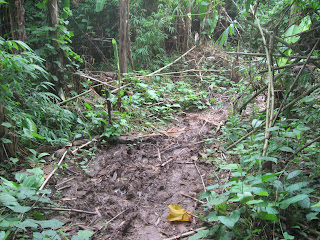
Overall the trip was rewarding, mixing beauty with very difficult, strenuous slogs through the mud. When we finished, muscles aching and leeches removed, the memory of flying, seeing the rain forest at first hand and a sense of accomplishment meant it was a positive experience.
The trek involved a 4 hour walk into the rain forest including very high zip-wires/flying foxes across the valleys, two nights in a tree house in the the rain forest canopy, and then a walk out. I even took the optional 6 hour walk on the second day. Ideally you can see or hear gibbons near the tree houses but we weren't so lucky.

The zip-wires were a definite highlight. Pushing off from the platform you quickly gather pace as you whip passed bamboo and trees, with a rush break out of the last tree and then sail over the rain forest canopy 30ms below, the floor 2oms further, and have views stretching kilometres away over the rain forest. It's the closest I'll come to flying and only temporarily scary on the longer glides if you think about what you're doing.

 Another highlight was the opportunity to be in the rain forest, which is amazingly detailed a ground level and awe inspiring at canopy level. Noise never stops in the rain forest, even if our sightings of wildlife were low.
At the first local hut we stayed they had a pet baby Asian bear which was highly cute and pat-able. They had no plan of what to do with it when it reached adulthood.

The walks were particularly demand as, having chosen to take the trip in the wet season, most of the paths had turned to deep mud. Living in the mud were also highly active leeches. At one point I was eking along over a very deep mud patch, one foot on the less-slippery edges of the path when I looked down to see several large leeches waving up at me, begging me to slip. I didn't slip that time, but did on many occasions. Amazingly Claire & I managed to only get blood-sucked on one occasion each, though vigilance did lead to a lot of picking & flicking of leeches off shoes, legs and feet.

Overall the trip was rewarding, mixing beauty with very difficult, strenuous slogs through the mud. When we finished, muscles aching and leeches removed, the memory of flying, seeing the rain forest at first hand and a sense of accomplishment meant it was a positive experience.
16 July 2007
Chiang x 2 & Into Lao
After a lazy 17 hour over-night train ride Claire & I arrived in sunny Chiang Mai - the train being 3.5 hours late. Overnight the seats are converted into beds and are overall comfortable, in fact I would have liked a bit longer of a lie in.
Claire & I found my favourite guest house in Chiang Mai, which despite a change of name and ownership has found its way into the hands of an equally (though less quirky) Thai proprieter. (Siri Guest House, $14, really nice). We took a couple of quiet days in Chiang Mai with little done but reading and relaxing.
From Chiang my a hair-raising bus ride took us to Chiang Sean. Whilst the average speed of the bus looked respectable, it varied between very slow (1st gear - gravity x heavy bus) up steep hills to very fast (6th gear + gravity x heavy bus) on the mountaneous terrain. The north of Thailand is particularly beautiful, full of bright green forest/rain forest as the rainy season's just begun.
In Chiang Sean we had probably the best meal yet - the local delicacy roasted/baked fish or chicken cooked with a marinade of chilli and corriander inside a bamboo tube over coals. The town's very quite, but sits right on the Maekong river. We did, however, stay in a nightmare guest house (Gin's Guest House, $10) that should be avoided at all costs.
A sang taew (sort of a bus, more like a ute with benches & a roof) took us to the border crossing into Lao PDR. Tomorrow our adventure's in Lao begin after a night in a very nice guesthouse over looking the Maekong (BAP Guest House, $14).
Subscribe to:
Posts (Atom)